A007 - Jackson Pollock and Nature
Jackson Pollock and Nature
Advancement in science and technology as well as the growth of the middle class during the 19th century helped artists deviate from the subject matter in religion, monarchy and aristocracy, and instead focus on nature and expression of emotions towards nature. Also, it led to a great discovery in aesthetic beauty in color and forms independent of the content. Impressionists such as Manet, Monet, Pissarro are some of the leaders in this effort.
Ironically, however, this attention to formal elements in nature ended up a complete departure from nature in the later 20th centuries and on. Cézanne was probably the most pioneering artist for the departure. He claimed that everything in nature takes its form from the sphere, the cone and the cylinder. This directly influenced Braque and Picasso for their invention of Cubism. Kandinsky published Point and Line to Plane where he claimed that human emotion can be expressed by using pure (Euclidean) geometric shapes without reference to nature. In the late 20th century, an Abstract Expressionist, Agnes Martin created several paintings of pure grid, announcing that the grid forms, as being uninfluenced by anything, represent our pure state of mind, innocence. A modern sculptor, Donald Judd actually rejects most European artistic values of representation of space towards nature and instead pursues autonomy of geometrically constructed objects.
Nature is the manifestation of the highest order of being whether it is the words of God, the source, the principles, the truth or whatever people call it. We are part of the manifestation. Dutton claims, in The Art Instinct: Beauty, Pleasure, and Human Evolution, that human’s art appreciation is not only a social construct, but also an instinct as a result of evolution during which humans have developed a positive appreciation toward natural organic surroundings. At some point in the art history of humanity, we invented a scene without a single natural form in search of our pure innocence. Such scenes give no indication of growth or being weathered, that is, no past, no future. They are only a snapshot of present survival. Our innocence seems to have departed from the source, i.e., nature.
With that observation, I would like to analyze a work of art by Jackson Pollock. It is One: Number 31, 1950. When we encounter a Jackson Pollock’s work of art like this for the first time, we are puzzled by its unlikeness of presentation. It doesn’t seem to represent anything recognizable. In his painting, we find so much difference and uniqueness compared to the arts preceding his work. Art critics categorize him as an Abstract Expressionist and one of major players in New York School.
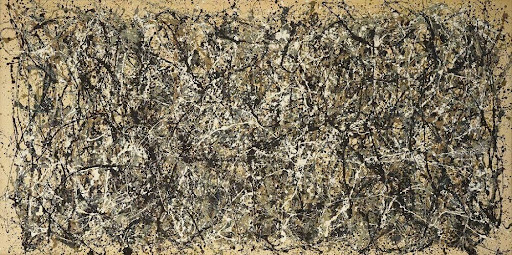
One: Number 31, 1950 - Oil and enamel paint on canvas, 8' 10" x 17' 5 ⅝.
His painting is considered an “all-over” painting where it doesn’t have any focal point, eye path or any narrative associated with it. Clement Greenberg, in his essay, American-Type Painting, articulated a concept of medium specificity in that modern works of art were more committed to inherent qualities of each different artistic medium. In particular, he saw Jackson Pollock's all-over paintings pursued emphasis on flatness as the two-dimensional reality of the painting medium, in contrast to the illusive space depicted in Renaissance paintings. It is the tactile type of plasticity in consideration of beauty, mentioned in The Artist’s Reality by Mark Rothko.
Pollock’s painting process is also very unique. Pollock often spread out an unstretched fabric on the floor and dribbled, dripped and poured paints onto the fabric. He worked with not only brushes but also sticks and sometimes poured paints right out of the can. His motion of painting followed more of random action rather than very calculated and controlled motion. Harold Rosenberg claimed that Pollock's action itself should be considered as actual work of art and the finished painting being only the physical residue. The spontaneous action of the painter through gestures, drips, splashes are all considered emanations of the automatic, subconscious mind, hence the revelation of our truth without being corrupted by consciousness.
It is interesting to see that Pollock relied on his automatic subconscious action in discovering the truth or our innocence, rather than assuming Euclidean geometric forms in Cézanne, Braque, Picasso, Mondrian, Agnes Martin and Donald Judd. I believe Pollock was a naturalist in his core. An episode illustrates this counter-reasoning very clearly. An Abstract Expressionist, Hans Hofmann visited Pollock’s studio, saw no still life or models in the studio, and asked Pollock if he worked from nature. Pollock responded: "I am nature." Hofmann then warned: "You don't work from nature, you work by heart. That's no good. You will repeat yourself." They both seemed to agree on the truth residing in nature, but Pollock relied on himself as nature itself while Hofmann seeing human consciousness deviated from nature.
Let us take a look at lines and shapes created by Pollock. They look random, far from the simplistic geometric shapes that many modern artists since Cézanne took as a form of truth. When we look closely, we notice that the lines with thicker brush strokes or drips repeat or interweave themselves with thinner ones. It gives an illusion that the same mesh of lines repeating itself infinitely into a smaller space. It is certain that similar shapes are repeating, yet there is a certain degree of perturbation along the repetition, which makes the whole layout look more chaotic than uniform. It is the result of his repetitive automatic actions.
We as humans respond to this self-similar repetition as comforting, harmonious and natural, which is probably similar to our aesthetic experiences toward texture in nature such as trees, clouds, barks, ripples in a lake, weathered rocks and winding rivers. In 1975, Dr. Mandelbrot invented an algorithmic formula to generate self-similar shapes into infinity. It is called fractal. With fractal, the same shape can repeat itself into infinitely larger or smaller scales. By introducing a controlled perturbation during repetition, it can also produce chaotic, yet ordered repetition of similar shapes found in nature. It is known that Leonardo da Vinci laid out a formula to generate tree branches without having to have a real tree to draw. The formula turned out to be an example of fractal. Fractals can generate shapes of leaves, branches, flowers, river flow, clouds, eroded mountains and many others in nature. All the shapes are a result of self-similar repetition with a certain degree of variation. That is, modern mathematics has proved that natural forms are never a form of Euclidean geometry that many modern artists imagined.
Late investigations by many scholars on Jackson Pollock’s paintings revealed that the lines and shapes in his paintings indeed follow fractal principles. Obviously, his pursuit of truth in forms preceded the discovery of fractals in mathematics. Yet, his reliance on himself as nature itself created the forms of truth, which are the principles in the forms of nature. The greatest contribution of Pollock then may be that he attempted to bring us back to nature in pursuit of our innocence after we divorced nature since Cézanne. All-over painting, action painting are just critic’s takes on his means, rather than his ultimate pursuit.
November 2020
Pyungchul Kim